
Set in 1900 England, Goodbye, My Rose Garden tells the story of the young noblewoman Alice and her maid Hanako as the two connect over their shared passion for fiction and eventually fall in love. Steeped in references to the history and literature of the Victorian era, the series draws on turn-of-the-century reality and fantasy alike to highlight the intersectional struggles of queer women of the period.
Utilizing the narrative devices of early feminist and women-loving-women (wlw) literature, Rose Garden encourages its audience to expect a melancholy love story. However, it swerves in its finale to offer an unambiguously romantic, happy ending, arguing against “inevitable” heteronormativity and providing a shining example of how to write nuanced, happy historical queer fiction for a modern audience.
Click here for the full article on Anime Feminist!
If you like the dishes AniFem is serving up, please consider becoming a patron for as little as $1 a month!


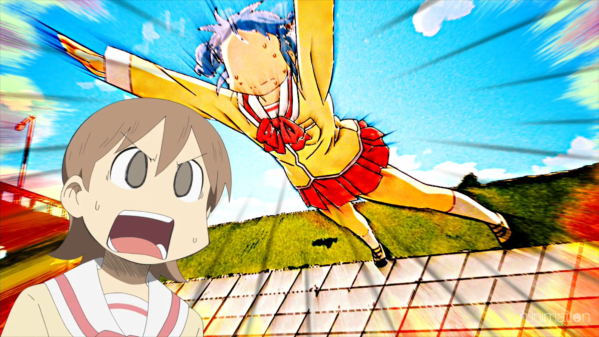 Adapted from the manga by Keiichi Arawi and vibrantly animated by Kyoto Animation, this comedy featuring robots, talking cats, and murderous deer initially sounds far from “ordinary.” However, Nichijou‘s dedication to finding reality through absurdity—to showing how things feel rather than how they literally are—grants the series an authenticity that many grounded YA dramas struggle to capture.
More to the point, it accomplishes this with a cast largely composed of high school girls—in particular, the central crew of Yuuko, Mio, Mai, and Nano. Through these girls’ diverse personalities and adventures, Nichijou not only showcases many common (and not-so-common) trials and triumphs of modern female adolescence and friendship, but also expands the narrow idea of what it means to be a “normal” teen girl in fiction.
Adapted from the manga by Keiichi Arawi and vibrantly animated by Kyoto Animation, this comedy featuring robots, talking cats, and murderous deer initially sounds far from “ordinary.” However, Nichijou‘s dedication to finding reality through absurdity—to showing how things feel rather than how they literally are—grants the series an authenticity that many grounded YA dramas struggle to capture.
More to the point, it accomplishes this with a cast largely composed of high school girls—in particular, the central crew of Yuuko, Mio, Mai, and Nano. Through these girls’ diverse personalities and adventures, Nichijou not only showcases many common (and not-so-common) trials and triumphs of modern female adolescence and friendship, but also expands the narrow idea of what it means to be a “normal” teen girl in fiction.



 The Josei Next Door